Physical AI
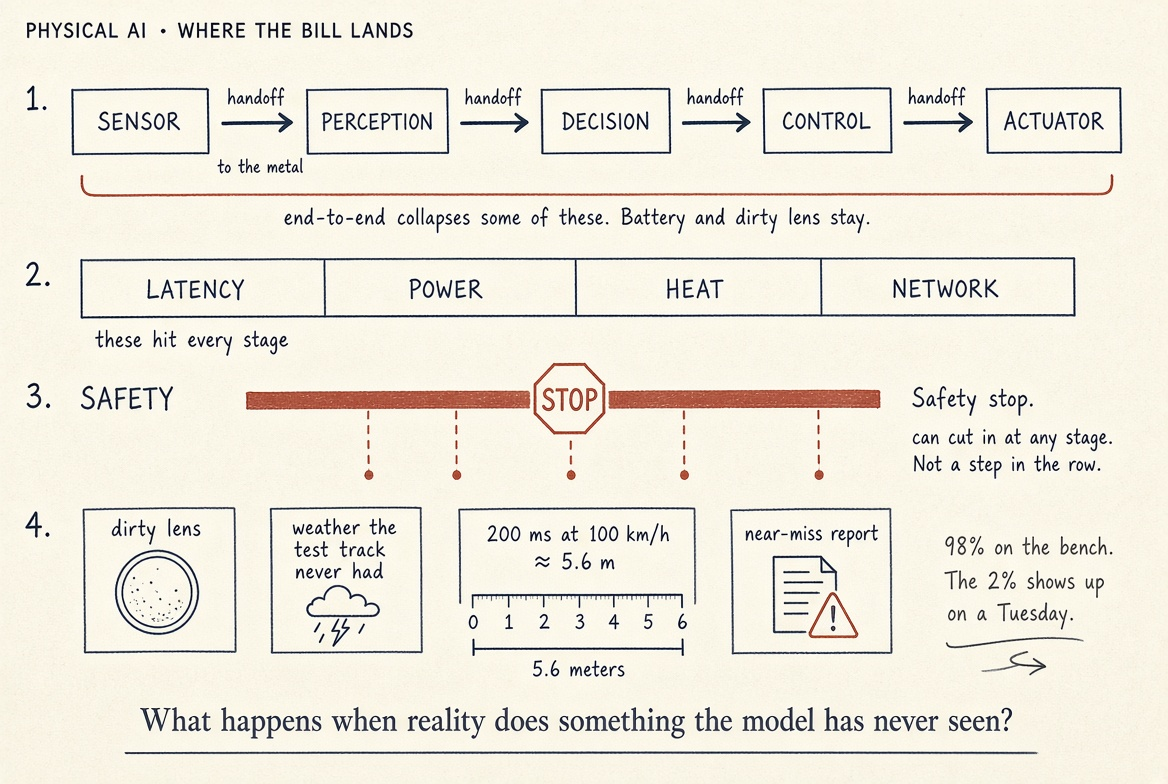
A model can hit 98 percent on its benchmark and the product can still be useless.
The 2 percent the world invents on a Tuesday is the product.
Everyone is watching the model. I think they're watching the wrong thing.
I've spent enough time around autonomy and robotics to know where the bill lands once a system leaves the lab. In the handoffs.
Sensor to perception. Perception to decision. Decision to control. Control to the metal.
Every one of those is a place to fail.
I've watched latency eat a plan that was fine on a bench. I've watched a power budget kill an architecture that looked clean in a slide. And a demo that held until the world stopped behaving like the test track.
Once AI leaves the browser, physics gets a vote. Heat and the network get one too, and the edge case nobody trained on gets the loudest. A wrong call used to cost you a bad paragraph. Put it next to a person and somebody files a near-miss report.
My bet is that Physical AI goes to whoever owns the system around the model. Sensors, data, edge compute, memory, latency, power. Simulation that's honest about failure. A safety layer that can stop the machine. And a loop that learns from whatever the fleet ran into last week, because the edge cases somebody scripted into the test plan passed a long time ago and those aren't the ones that hurt you.
In my opinion the investment mistake right now is staring at the model and treating everything wrapped around it as integration work someone else will finish. The model is one component. When reality gets messy, the customer is trusting the whole stack.
The best argument against me is end-to-end learning. If one network runs from pixels to motor commands, some of those handoffs collapse into it. The battery and the dirty lens stay. I don't know yet how much of the bill that moves.
If you have data that breaks this hypothesis, email me.